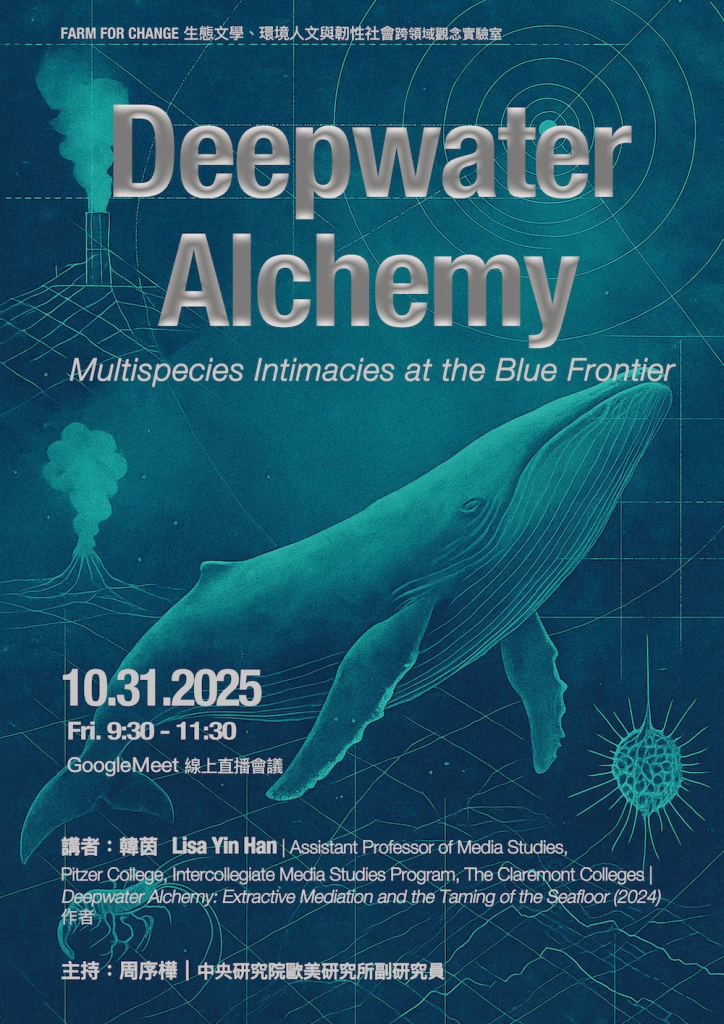
【學術演講】Farm for Change觀念實驗室演講訊息 | Deepwater Alchemy: Multispecies Intimacies at the Blue Frontier | 2025.10.31

Deepwater Alchemy: Multispecies Intimacies at the Blue Frontier
講者:Lisa Yin Han 韓茵|Assistant Professor of Media Studies, Pitzer College, Intercollegiate Media Studies Program, The Claremont Colleges|Deepwater Alchemy: Extractive Mediation and the Taming of the Seafloor (2024) 作者
主持:周序樺|中央研究院歐美研究所副研究員
時間:2025年10月31日(五)9:30~11:30
地點:Google Meet線上會議直播
主題簡介
We often take for granted the sensing and imaging processes that have made human activities such as offshore drilling, deep sea mining, and archaeological excavation at the ocean bottom possible today. Yet media technologies such as sonar-based surveys, underwater cameras, digital modeling, and more have played a key role in both representing the seafloor as a space of potential profits, even when they are also used for environmentalist aims. Deepwater Alchemy: Extractive Mediation and the Taming of the Seafloor makes the case that the historical development of underwater media technologies has been complicit in perpetuating logics of extraction, exploitation, and militarism in our global oceans. From towed hydrophones to networked ocean observation, the hunt for resources has driven the imaging of the ocean floor and vice versa, imperiling fragile deep ocean ecosystems in the process.

Building on the book’s exploration of techniques such as petroleum seismology and animal-borne sensing, this talk will delve deeper into the role of whales and other marine animals in media assemblages as both victims and collaborators in global ocean mediation. What are the stakes of bringing images of oil and other ocean resources to life through processes that simultaneously produce death? How might a multispecies perspective on ocean mediation dismantle existing hierarchies of knowledge and sense? Han’s book critiques the epistemological and ideological biases inherent in the pursuit of global ocean media coverage and human presence in the deep sea, contending that such values are borrowed from terrestrial knowledge regimes, colonial notions of the frontier, and anthropocentric perspectives on environment. As the seafloor becomes increasingly accessible to humans, it becomes all the more important to attune our senses to those of others creatures, from the tiniest zooplankton to our oceanic giants.

講者簡介
Lisa Yin Han is an Assistant Professor of Media Studies at Pitzer College, in the Claremont Colleges Intercollegiate Media Studies Field Group. Situated at the intersections of environmental media studies, critical ocean studies, and science and technology studies, Lisa’s work is informed by a dedication to social and environmental justice. Her book, Deepwater Alchemy: Extractive Mediation and the Taming of the Seafloor (University of Minnesota Press, 2024), examines how media operations in deep ocean environments pave the way for extractive industries. Lisa also works as a reviews co-editor for the Journal of Environmental Media and is an affiliate of the Humanities for Environment North American and Asia-Pacific Observatories.

報名:https://forms.gle/VdJq5mM5QfZbuPkW7
種種看活動網頁:Deepwater Alchemy: Multispecies Intimacies at the Blue Frontier
【徵稿啟事】Critical Canons International Symposium, 6–7 December 2025

International Symposium & Call for Papers
Sponsored by the MOE World Excellence 100 Project

Theme: Critical Canons: Rethinking Aesthetics in a More-Than-Human World
Organizer: Co-hosted by the Department of English & Department of Philosophy, National Chengchi University, Taipei, Taiwan
Date: 6–7 December 2025
Venue: National Chengchi University, Taipei, Taiwan

Deadline for submission: 20 September 2025

Description:

In The Western Canon: The Books and School of the Ages, Harold Bloom warns us: “If we read the Western Canon in order to form our social, political, or personal moral values, I firmly believe we will become monsters of selfishness and exploitation.” Bloom’s provocation invites us to reconsider not merely what constitutes a canon, but the epistemological, ethical, and ecological conditions under which canons are formed, sustained, and transformed. Similarly, following distinct yet overlapping notions advanced by John Guillory in Cultural Capital: The Problem of Literary Canon Formation, the processes in which canons emerge and are disputed are animated by protocols of the distribution of literary and cultural capital enacted within academic, political, and cultural institutions. In the twenty-first century—marked by the Anthropocene’s ecological disruptions, the intensification of extractive capitalism, and the emergence of AI-generated cultural forms—our inherited and contested literary and philosophical canons call for renewed critical engagement.

In our symposium theme, “Critical Canons”—a term that means both canons under critical scrutiny and canons of critical importance—the word critical signals not only the need to interrogate and reevaluate canons, but also their essential role in shaping thought and cultural transmission. Canons are neither neutral repositories nor immutable monuments. They are dynamic, relational constellations of texts, images, and ideas, shaped by historical contingencies and cultural negotiations. They can be as rooted as the Shijing’s “Green, green, grass on the riverbank,” yet as diffuse and proliferating as Whitman’s “leaves of grass.” They can speak in Dickinson’s “murmur of a Bee,” or shimmer in Zhuangzi’s “happy fish” dialogue, which can reframe perception as an act of shared joy and being-with. The multiple meanings of the term resonate with our central inquiry: in a more-than-human world, how might canons be redefined, reinterpreted, and reimagined? What are the processes, located in multiple overlapping institutional contexts, which inform the inclusionary and exclusionary gestures of canon formation?

The symposium intends to demonstrate how aesthetic canons across cultures and institutions are not solely textual, social-political, or theoretical constructs but also material and ethical sites in which human and more-than-human agencies converge. While literary, linguistic, and cultural studies contribute narrative, figural, epistemological, and various affective modes of world-making, philosophy provides the conceptual and critical frameworks necessary to interrogate the ontological and normative grounds of canon formation. Taken together, these disciplinary perspectives underscore the productive tensions between close reading and abstraction, between historical particularity and planetary universality—tensions that disclose the generative possibilities of rethinking aesthetics in a more-than-human world. We therefore encourage contributions that explore these intersections from philosophical, literary, and interdisciplinary perspectives, with particular attention to the challenges and opportunities of collaborative inquiry.

We aim to be inclusive and interdisciplinary by inviting contributions along two complementary lines of inquiry: First, we welcome critical analyses of the processes, contexts, and more-than-human agencies involved in the formation, contestation, and transmission of canons. This includes attention to mechanisms of power, cultural capital, ecologies, and institutions that shape what can be considered ‘canonical.’ Second, we encourage interpretive, reflective, or innovative readings of particular canonical texts, ideas, or traditions. We seek papers that illuminate how the meanings and resonances of foundational works shift across temporal, cultural, ecological, or interspecies boundaries, and that attend to the elements, contexts, and stakeholders that participate in their reinterpretation. By bridging these approaches, the symposium provides a platform for both the critical interrogation of canon-making and the creative reinvestigation of canonical works themselves, fostering productive tension and dialogue between theory and practice, structure and interpretation, and between historical particularity and planetary universality.

This symposium is an invitation to re-read, re-hear, and re-compose the canon—not as a fixed archive of human achievement, but as a living, breathing, multi-species conversation. This symposium seeks to reconceptualize aesthetics and canonical formation through a more-than-human lens, engaging cross-cultural, cross-temporal, and cross-species perspectives. We ask:
How might Asian philosophical traditions — Confucian, Daoist, Buddhist, and beyond — of interdependence reshape the ethical and aesthetic underpinnings of canon formation?
How might indigenous cosmologies, local folklore and religious practice, and archipelagic aesthetics reimagine the canon as a network of reciprocal relations rather than a hierarchical archive?
How might Western philosophical thoughts – Ancient Greek and Roman philosophies, Enlightenment and Romantic ideas, etc. —traditions deeply implicated in both ecological imaginaries and natural histories—be re-read in dialogue with Asian classical philosophy and contemporary environmental humanities?
How might the emergence of AI authorship and algorithmic aesthetics compel us to revisit the notions of canon, tradition, and originality, and the temporalities of cultural transmission?
By bringing together scholars of literature, philosophy, cultural studies, media theory, and the arts, this gathering will explore how canons—classical and emergent—can be critically reimagined to account for more-than-human forms of creativity.

Possible Topics:

We welcome proposals addressing, but not limited to, the following:
Theoretical and institutional analyses of canon formation and transmission (including more-than-human perspectives)
Close readings, reinterpretations, or critical reflections on specific canonical texts, ideas, or traditions
Extractive capitalism, ecological justice, and the politics of representation
Asian and non-Asian ethics and aesthetics of interdependence and care
Indigenous oral traditions, folklore and religious practice
Enlightenment and Romanticism re-read in the context of planetary crisis
Classics and ancient histories reframed through more-than-human perspectives
Comparative poetics and transcultural thought
Storytelling as a multi-species survival strategy in the Anthropocene
The ethics of reading and the politics of canon-making
Materiality, temporality, and translation in cross-cultural canon formation
AI authorship, algorithmic aesthetics, and the redefinition of creativity
Format & Structure:

The symposium is an in-person event and is structured as follows:
Day 1: Keynote lectures, plenary panels, and interdisciplinary dialogues among scholars, artists, and practitioners.
Day 2: Thematic breakout sessions, creative workshops, field trips and a closing roundtable envisioning “A More-Than-Human Canon.”

Submission Guidelines
Abstract: 300 words
Short bio: 100 words
Language: English
Deadline for submission: 20 September 2025
Symposium email contact:
Ken Wu (110551502@g.nccu.edu.tw) & Yves Lin (111154010@nccu.edu.tw)
Please include your name, institutional affiliation, contact details, and whether your presentation will be scholarly, creative, or hybrid.


國際研討會暨徵稿啟事
教育部「世界卓越100支持計畫」補助

主題:典律批判:「多物種世界」中重思美學
主辦單位:國立政治大學英文系、國立政治大學哲學系
時間:2025年12月6日至7日
地點:國立政治大學(台灣,台北)

投稿截止日期:2025年9月20日

研討會簡介

在《西方正典》(The Western Canon: The Books and School of the Ages)一書中,哈洛・卜倫(Harold Bloom)警告我們:「如果我們閱讀西方正典只是為了建立社會、政治或個人的道德價值觀,我堅信我們將成為自私與剝削的怪物。」卜倫的挑釁迫使我們重新思考的不僅是典律本身的構成,更是典律生成、維繫與轉化的認識論、倫理學與生態學條件。同樣地,約翰・吉洛里(John Guillory)在《文化資本:文學典律形成的問題》(Cultural Capital: The Problem of Literary Canon Formation)中提出相關但不盡相同的觀點:典律的出現與爭議,其過程背後乃由學術、政治與文化制度中關於文學與文化資本分配的規範所驅動。進入二十一世紀,面對人類世的生態危機、掠奪式資本主義的加劇,以及人工智慧所生成的新興文化形式,我們繼承並爭論的文學與哲學典律,都迫切需要新的批判性介入。

在本次研討會主題「典律批判」(Critical Canons)中,「critical」既指典律須受批判性檢視,同時也表明典律在思想與文化傳遞中具關鍵性的重要角色。典律既非中立的典藏,亦非不變的紀念碑,而是由歷史偶然性與文化協商所形塑的動態關係網絡,由文本、圖像與思想交織而成。它既可如《詩經》中「青青河畔草」般深根固植,又可如惠特曼《草葉集》般繁衍擴散;既能在狄謹蓀的「蜜蜂低語」中發聲,也能在《莊子》的「魚之樂」對話中閃爍,重新界定知覺為共享之樂與共存的行動。這些多重意涵呼應我們的核心問題:在「多物種世界」(a more-than-human world)中,典律如何能被重新定義、詮釋與想像?在重疊的多重制度語境中,典律形成中的納入與排除機制如何被理解?

本研討會旨在展示:跨文化與制度的美學典律,不僅是文本、社會政治或理論的構造,同時亦是人類與非人類能動性交會的物質與倫理場域。文學、語言與文化研究提供了敘事、修辭、認識論與各種情感形式的「世界製造」模式;哲學則提供了概念與批判框架,以檢視典律形成的本體論與規範性基礎。兩者結合凸顯了細讀與抽象、歷史特殊性與行星普遍性之間的張力,而這些張力揭示了在「多物種世界」中重新思考美學的創生可能。我們因此鼓勵從哲學、文學與跨學科的角度,探討這些交會,並特別關注協作探究的挑戰與機會。

我們的目標是以開放與跨領域的方式推動討論,並邀請以下兩類研究:第一,針對典律形成、爭議與傳遞過程中涉及的制度語境與非人類能動性進行批判分析,包括權力、文化資本、生態與制度等機制如何界定「何者得以成為典律」;第二,對特定典律文本、思想或傳統進行詮釋、反思或創新性閱讀,闡明基礎性作品如何跨越時間、文化、生態或跨物種界線而改變其意涵與共鳴,並探討參與其再詮釋的要素、語境與行動者。透過此雙重取徑,研討會將成為檢視典律形成與再探典律文本之平台,並促進理論與實踐、結構與詮釋、歷史特殊性與行星普遍性之間的對話。

本研討會邀請與會者「再閱讀、再聆聽、再編織」典律——不將其視為固定的人類成就檔案,而是一場有生命力的、多物種的對話。我們期望透過跨文化、跨時代與跨物種的觀點,重新構思美學與典律形成。具體問題包括:
亞洲哲學傳統(儒、道、佛及其他)中關於相互依存的思想,如何重塑典律形成的倫理與美學基礎?
原住民宇宙觀、在地民間傳說與宗教實踐,以及群島美學,如何將典律想像為互惠關係的網絡,而非階層式的典藏?
西方哲學傳統(古希臘羅馬哲學、啟蒙與浪漫主義等)——這些與生態想像與自然史密切相關的傳統——如何能與亞洲古典哲學及當代環境人文對話?
人工智慧寫作與演算法美學的興起,如何迫使我們重新思考典律、傳統、原創性,以及文化傳遞的時間性?
透過匯聚文學、哲學、文化研究、媒體理論與藝術領域的學者,本研討會將探索如何批判性地重新想像古典與新興的典律,使其能回應「多物種」的創造形式。

徵稿主題(包含但不限於):
典律形成與傳遞的理論與制度分析(含「多物種」的觀點)
特定典律文本、思想或傳統的細讀、再詮釋或批判反思
掠奪式資本主義、生態正義與再現政治
亞洲與非亞洲的依存與關懷的倫理與美學
原住民族口傳傳統、民間傳說與宗教實踐
啟蒙與浪漫主義在行星危機下的再閱讀
古典文獻與古代歷史的「多物種」重釋
比較詩學與跨文化思想
敘事作為人類世中的多物種生存策略
閱讀倫理與典律建構的政治
跨文化典律形成中的物質性、時間性與翻譯問題
人工智慧寫作、演算法美學與創造力的再定義
會議形式與結構

研討會為實體進行,規劃如下:
第一天:專題演講、大會論壇、學者與藝術實踐者跨領域對話
第二天:主題分組、創意工作坊、田野活動,以及閉幕圓桌論壇「多物種典律」
投稿須知
摘要:300字
作者簡介:100字
投稿語言:英文
投稿截止日期:2025年9月20日
投稿信箱:Ken Wu (110551502@g.nccu.edu.tw)、Yves Lin (111154010@nccu.edu.tw)
投稿請附上姓名、服務單位、聯絡方式,並註明報告形式(學術性、創意性或混合性)。

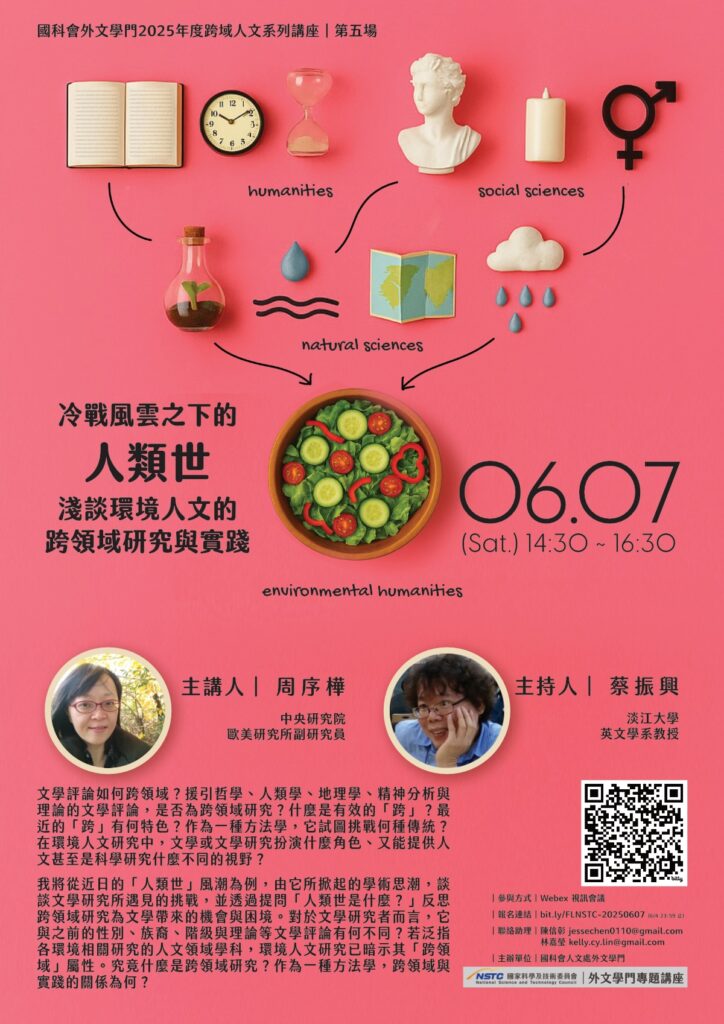
【學術演講】6/7「冷戰風雲之下的人類世:淺談環境人文的跨領域研究與實踐」線上論壇|國科會外文學門 2025 年度跨域人文系列講座第五場

▌ 國科會外文學門 2025 年度跨域人文系列講座・第五場論壇 ▌

主題|冷戰風雲之下的「人類世」:淺談環境人文的跨領域研究與實踐
講者|周序樺|中央研究院歐美研究所副研究員
主持|蔡振興|淡江大學英文學系教授
時間|2025年06月07日(六)14:30~16:30
線上|Webex 視訊會議 |連結將於活動前兩天,寄送至報名所使用信箱
報名|https://bit.ly/FLNSTC-20250607,6/4(三)23:59 截止
主辦單位|國科會人文處外文學門
聯絡助理|陳信彰 jessechen0110@gmail.com;林嘉瑩 kelly.cy.lin@gmail.com

——————

▌ 演講簡介 ▌

文學評論如何跨領域?援引哲學、人類學、地理學、精神分析與理論的文學評論,是否為跨領域研究?什麼是有效的「跨」?最近的「跨」有何特色?作為一種方法學,它試圖挑戰何種傳統?在環境人文研究(environmental humanities)中,文學或文學研究扮演什麼角色、又能提供人文甚至是科學研究什麼不同的視野?

西方生態批評(ecocriticism)發展的歷史脈絡顯示,六○、七○年代至今、冷戰與大歷史敘述之下的西方反文化運動(counterculture)召喚實用主義(pragmatism)精神,由看似微不足道的「日常」環境行動出發,奠定環境人文「跨領域」研究的學術視野。但如同大多反文化運動在被主流文化所接納、甚至是受歡迎的同時,環境人文研究也終究必須面對淪為意識形態與政治口號挑戰的宿命。

我將從近日的「人類世」 (Anthropocene)風潮為例,由它所掀起的學術思潮,談談文學研究所遇見的挑戰,並透過提問「人類世是什麼?」反思跨領域研究為文學帶來的機會與困境。對於文學研究者而言,它與之前的性別、族裔、階級與理論等文學評論有何不同?若泛指各環境相關研究的人文領域學科,環境人文研究已暗示其「跨領域」屬性。究竟什麼是跨領域研究?作為一種方法學,跨領域與實踐的關係為何?

——————

▌主講人與主持人簡介 ▌

主講人| 周序樺
美國南加州大學比較文學博士,現任中央研究院歐美研究所副研究員,「Farm for Change」氣候變遷:生態文學、環境人文與韌性社會跨領域觀念實驗室主持人。 曾任中山大學外國語文學系助理教授、副教授;主要研究領域為美國環境文學與環境論述,近年學術志趣包含美國有機農業書寫、後殖民環境論述、亞裔美國環境書寫等。

主持人| 蔡振興
國立臺灣大學外文所比較文學博士。淡江大學英文系教授,為陽明交大「醫療人文淑世計畫」團隊成員,也是現任中華民國文學與環境學會(ASLE-Taiwan)理事長。曾任淡江大學英文系系主任、英美文學學會理事長、中華民國比較文學學會理事長、中華民國文學與環境學會(ASLE-Taiwan)理事長,以及Tamkang Review和《英美文學評論》等主編。主要研究領域為文學理論、史耐德研究、全球暖化論述、生態文學和醫療人文研究。論文發表於Comparative Literature Studies、Neohelicon、《中外文學》、《英美文學評論》、《歐美研究》和《中山人文學報》等國內外期刊。主要著作有Gary Snyder, Nature and Ecological Communication,以及《生態危機與文學研究》(榮獲第八屆中央研究院人文及社會科學學術性專書獎)。主編《生態文學概論》、Key Readings in Ecocriticism (合編)等。最新論文〈醫療人文中的疾病書寫〉(2020)、〈敘述失能:林區《邊界之歌》中的邊界政治、自閉症與大地藝術〉分別收錄於《人文與社會科學簡訊》與《文學、視覺文化與醫學:醫療文人論文集》,馮品佳主編〈臺北:書林,2020),以及 “Toward an Ethics of Transcorporeality and public Health in Taiwanese Ecopathodocumentary”,收錄於The Bloombury Handbook to The Medical-Environmental Humanties (2022)。2023年主編《文學薪傳:臺灣的英美文學研究(2001-2022)》,2024年與林耀福合編《環境文學:物我去殖藝與醫》。

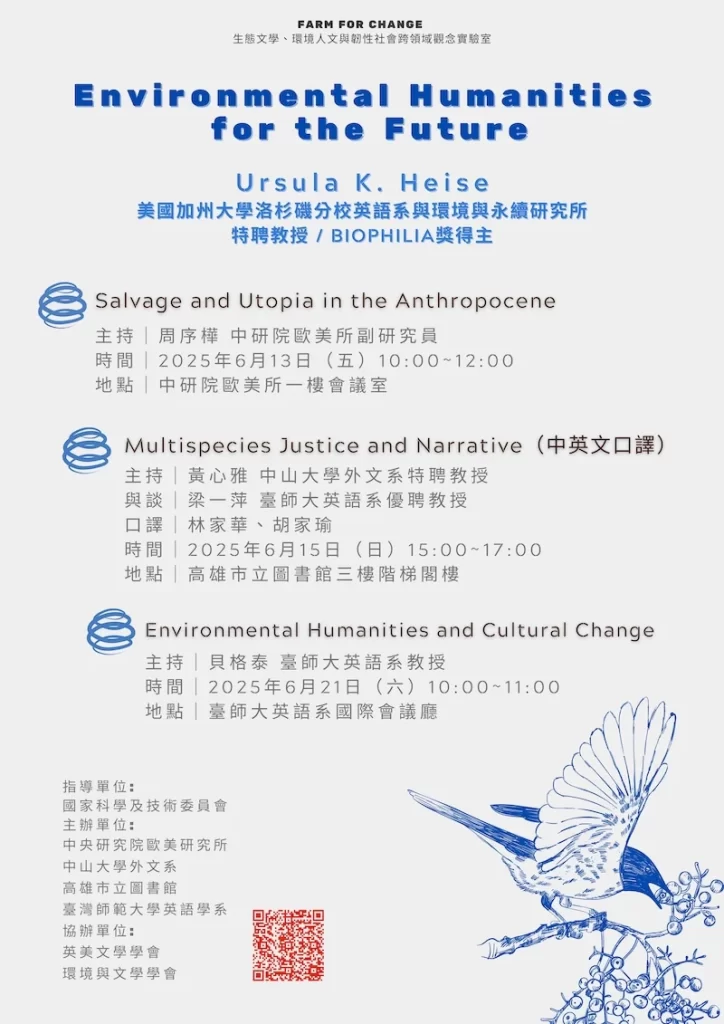
【學術演講】Farm for Change觀念實驗室演講訊息 | Salvage and Utopia in the Anthropocene | 2025.06.13

Salvage and Utopia in the Anthropocene|Environmental Humanities for the Future 系列講座一
講者:Ursula K. Heise|美國加州大學洛杉磯分校英語系與環境與永續研究所特聘教授|Biophilia獎得主
主持:周序樺|中央研究院歐美研究所副研究員
時間:2025年6月13日(五)10:00~12:00
地點:中央研究院歐美研究所一樓會議室(本場僅開放實體參與,6/8日中午12點截止)

主題簡介
Fictional texts, especially but not only futuristic ones, have often foregrounded the motif of salvage over the last few decades, from the brothers Strugatsky and Frederik Pohl to Alastair Reynolds and China Miéville: salvage of the artifacts of long-extinct alien civilizations as well as salvage of a vanished civilization that is easily recognizable as our current one. The artist Adrián Villar Rojas has portrayed similar themes in his pseudo-geological installations. This lecture will explore how the gradual discovery and interpretation of civilizations of the past in these fictions and artworks map futures beyond the Anthropocene, sometimes in a dystopian mode, but sometimes to open up optimistic or even utopian visions of environmental futures. This lecture will argue that such texts and artworks translate and upgrade into narrative theoretical approaches to the Anthropocene articulated by Anna Tsing, Nils Bubandt, and others who have sought to articulate paths forward from what they frame as the “ruins of capitalism.” By confronting characters with the remnants of modernity from the perspective of profoundly different future societies, speculative fictions focused on salvage seek to develop blueprints for social and environmental futures that offer alternatives to differently construed present moments.

講者簡介
Ursula K. Heise教授是環境人文學領域的先驅,專注於全球化與在地化交織的環境議題,強調跨文化理解對於應對氣候變遷與生物多樣性喪失的必要性。她的開創性研究「生態世界主義」探討環境倫理與瀕危物種的文化意義,並推動環境人文學的國際發展。Heise教授曾獲得古根漢獎,並於2024年榮獲西班牙BBVA基金會Biophilia獎,該獎項旨在表彰對於重塑人類與自然關係有卓越貢獻的學者,特別是在環境危機與生物多樣性保護方面的創新研究。她的代表作包括《地方感與星球感:環境想像下的全球》(牛津大學出版,2008)、《想像滅絕:瀕危物種的文化意義》(芝加哥大學出版,2016)、以及與其他學者共同編輯的《Routledge環境人文學指南》(2017)和《越南的環境與敘事》(2023),這些作品深入探討環境倫理、物種滅絕、跨文化環境理解以及生態正義等議題,對當代環境人文學與全球生態運動具有深遠影響。Heise教授近期的學術興趣包括科幻文學與環境未來,目前正著手撰寫專書《重拾生態烏托邦:科幻小說與環境未來》(Reclaiming Ecotopia: Science Fiction and Environmental Futures),探討科幻文學如何為人類世提供非末世化的想像,也為環境運動提供啟示與新的契機。Heise教授積極促進跨領域合作,建立全球性的學者網絡,她的學術貢獻不僅限於歐美,亦深入亞洲與拉丁美洲,對全球環境人文學的發展產生了重要影響,堪稱當代環境人文學領域的重要指標性學者。

報名:https://forms.gle/LNch63YYmnCUyVSf7
種種看活動網頁:Salvage and Utopia in the Anthropocene

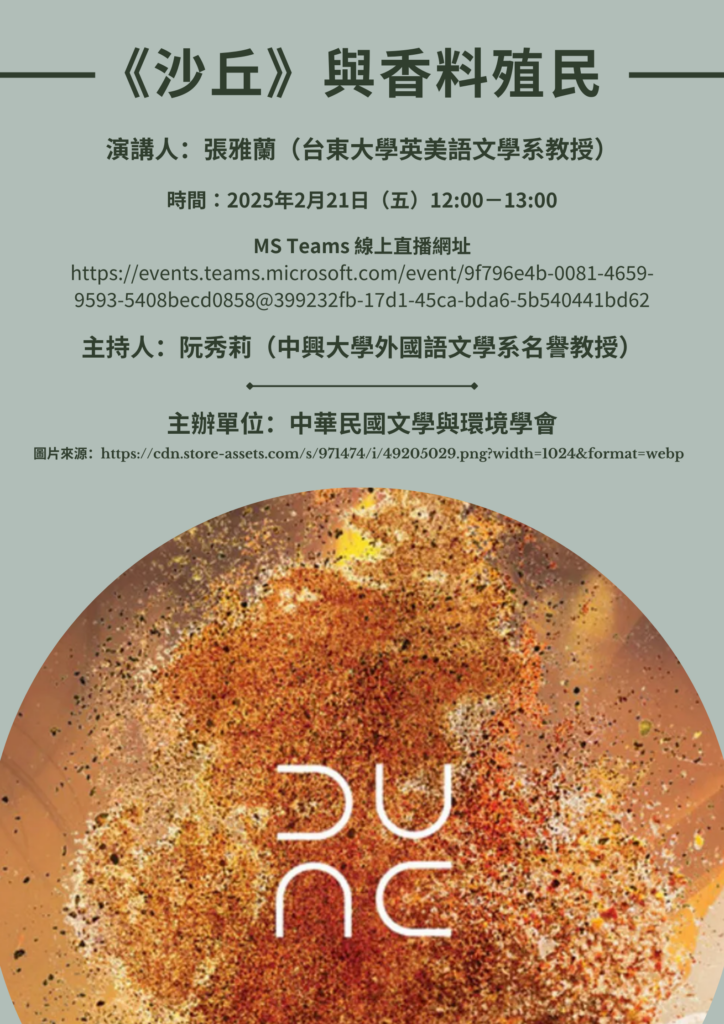
【學術演講】2/21 線上演講: 《沙丘 》與香料殖民 (中華民國文學與環境學會主辦)

主講人:張雅蘭 (臺東大學英美語文學系教授)
主持人:阮秀莉 (中興大學外國語文學系名譽教授)
日期:2月 21日 (星期五)
時間:12:00 – 1:00 P.M. (以 Microsoft Teams線上舉辦)
講題:《沙丘》與香料殖民
會議連結:https://teams.microsoft.com/l/meetup-join/19%3ameeting_YWNlZjgxM2QtZmZkNC00MWUyLWJlMWItMzY4N2UwM2RiM2Ey%40thread.v2/0?context=%7b%22Tid%22%3a%22399232fb-17d1-45ca-bda6-5b540441bd62%22%2c%22Oid%22%3a%2255895c48-48a5-4872-9b31-97cf0df8955a%22%7d

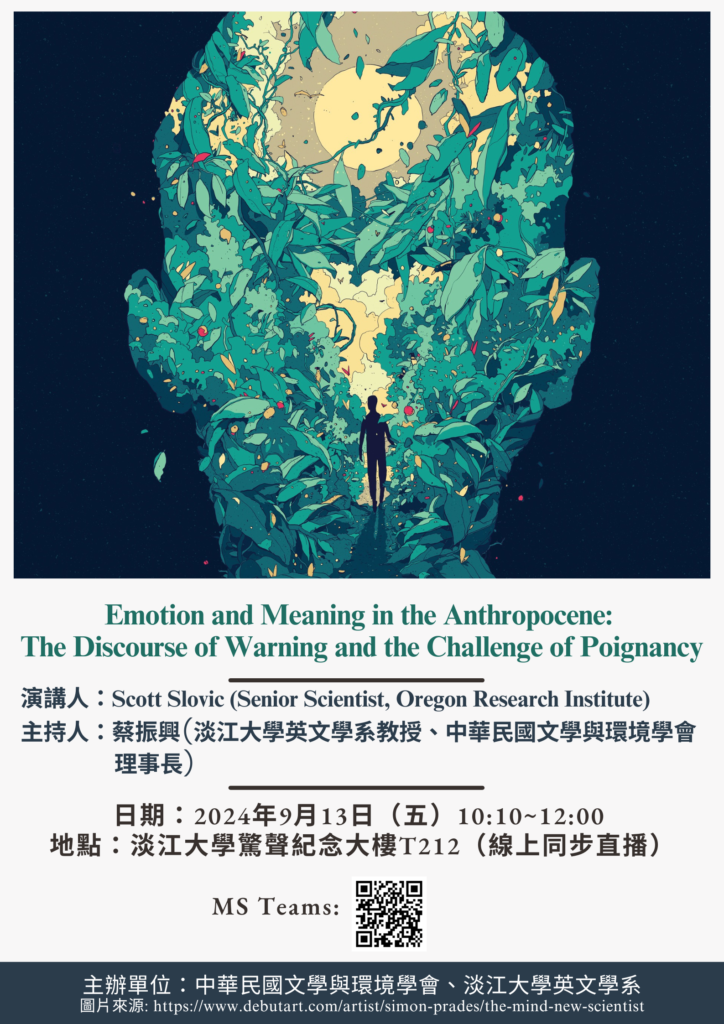
【學術演講】Professor Scott Slovic, “Emotion and Meaning in the Anthropocene: The Discourse of Warning and the Challenge of Poignancy” (Tamkang University)

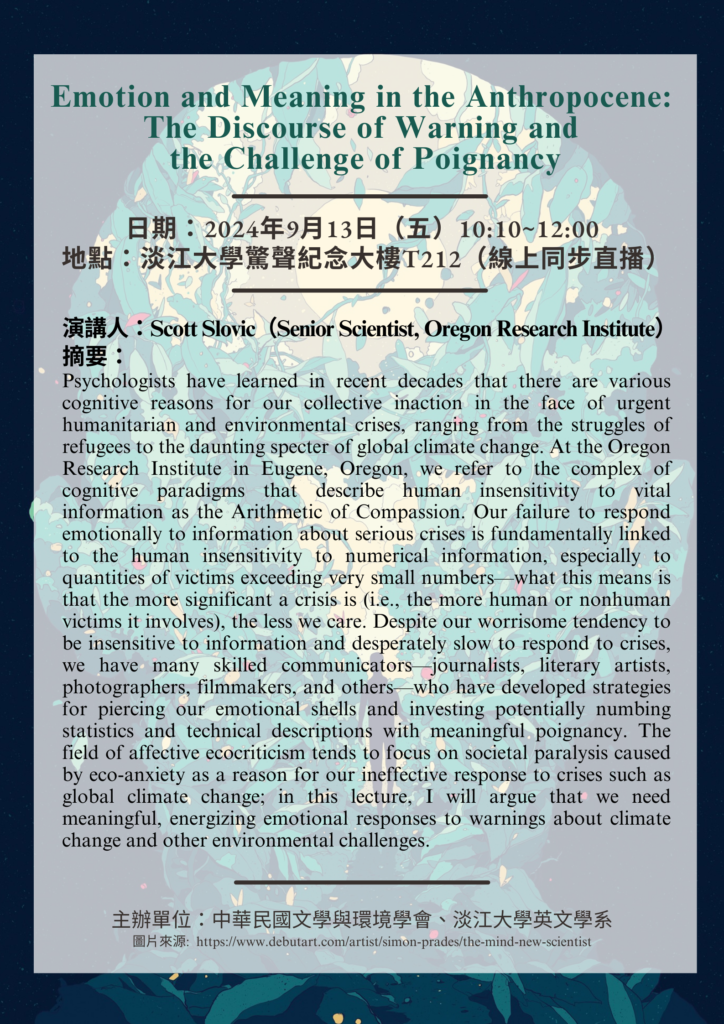
Psychologists have learned in recent decades that there are various cognitive reasons for our collective inaction in the face of urgent humanitarian and environmental crises, ranging from the struggles of refugees to the daunting specter of global climate change. At the Oregon Research Institute in Eugene, Oregon, we refer to the complex of cognitive paradigms that describe human insensitivity to vital information as the Arithmetic of Compassion. Our failure to respond emotionally to information about serious crises is fundamentally linked to the human insensitivity to numerical information, especially to quantities of victims exceeding very small numbers—what this means is that the more significant a crisis is (i.e., the more human or nonhuman victims it involves), the less we care. Despite our worrisome tendency to be insensitive to information and desperately slow to respond to crises, we have many skilled communicators—journalists, literary artists, photographers, filmmakers, and others—who have developed strategies for piercing our emotional shells and investing potentially numbing statistics and technical descriptions with meaningful poignancy. The field of affective ecocriticism tends to focus on societal paralysis caused by eco-anxiety as a reason for our ineffective response to crises such as global climate change; in this lecture, I will argue that we need meaningful, energizing emotional responses to warnings about climate change and other environmental challenges.

–Professor Scott Slovic

【學術演講】9/12 Online/Physical Lecture: Literary Nature Writing and the More-Than-Human Garden(中研院歐美所Farm for Change主辦)

演講主題
Literary Nature Writing and the More-Than-Human Garden

Ÿ 講者:Jessica J. Lee (李潔珂)|Course Director and Panel Tutor, Creative Writing-Nonfiction, University of Cambridge|Course Instructor, Orion Creative Writing Workshops|Course Director, Granta Nature Writing Workshop|Author of《山與林的深處》(2024)
Ÿ 主持:周序樺|中央研究院歐美研究所副研究員
Ÿ 時間:2024年9月12日(四)14:00
Ÿ 地點:中央研究院歐美所一樓會議室|視訊與實體並行

主題簡介
In this talk I’ll present my second book, Two Trees Make a Forest, which was published in 2019. Taking formal inspiration from novels The Stolen Bicycle (by Wu Ming-Yi) and Do Not Say We Have Nothing (by Madeleine Thien), Two Trees Make a Forest engages critically with the notion of memoir in the English-language nature writing genre: through an examination of the fragmentary stories of my grandparents’ lives, alongside the history of Taiwan itself, it asks how the genre can be expanded beyond the scope of Anglo-American landscapes without reifying an orientalist gaze. I’ll read briefly from the book before discussing its origins and formal and genre-specific challenges.

Literary Nature Writing and the More-Than-Human Garden: In this presentation, I’ll consider the ways gardens have been centred in three works of very recent contemporary nature writing: Unearthing by Kyo Maclear, Rootbound by Alice Vincent, and Uprooting by Marchelle Farrell. In each of these books, the story of the garden is complicated and far from idyllic, whether as a framework for understanding kindship and relation, a means for understanding individual coming-of-age against the background of urban life, or as a means for exploring the legacies of migration and empire. In each of these works, the garden is a way of leaning more closely into the world. I’ll consider the ways literary nature writing can provide a means for narrating one’s experience of more-than-human kinship and connection, and ultimately provide a complex re-imagining of tropes of the garden as escape or salve.

講者簡介
李潔珂 (Jessica J. Lee),作家、環境歷史學家,英國國王學院學士學位、倫敦大學碩士學位,加拿大約克大學環境史及環境美學博士。曾獲2019年RBC Taylor Prize潛力作家獎。著有《轉身:一部游泳回憶錄》(Turning: A Swimming Memoir),《山與林的深處:一位臺裔環境歷史學家的尋鄉之旅,在臺灣的植物、島嶼風光和歷史間探尋家族與自身的來處與記憶》(Two Trees Make a Forest) 是她的第二部著作,最新出版著作Dispersals: On Plants, Borders, and Belonging (Catapult, 2024)。

報名表單:https://forms.gle/31HP85B6zxuMXyVi9
活動網址:Literary Nature Writing and theMore-Than-Human Garden

本次演講採視訊方式進行,請於 9/10(二)前填寫報名表參加,並確實填寫您的聯絡資訊,主辦單位收到報名表後將於演講前以e-mail回覆線上會議室連結。

有任何問題,請來信 farmforchange2022@gmail.com

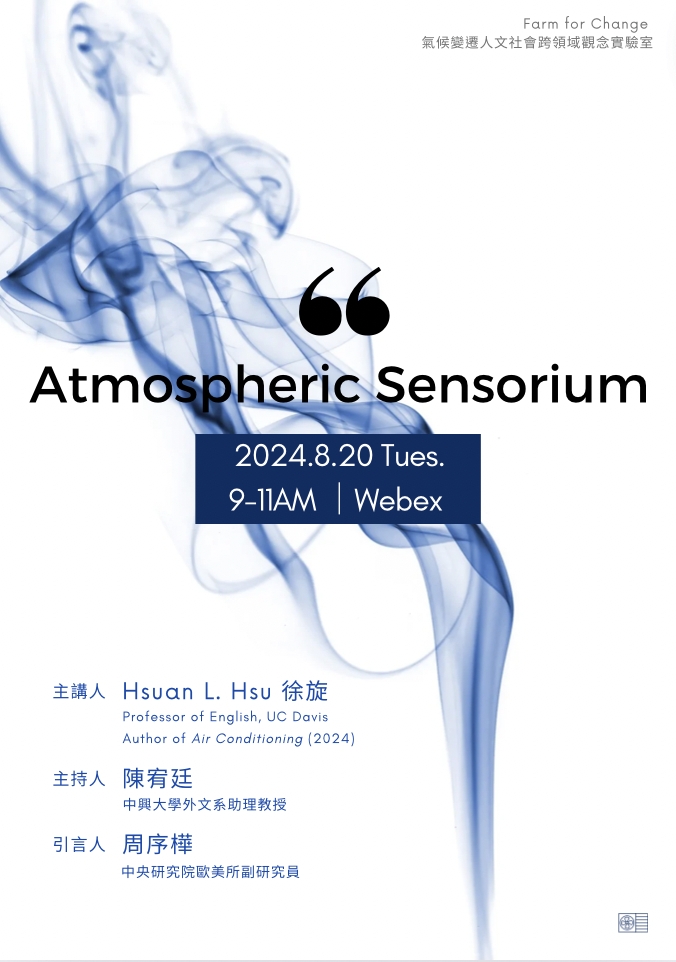
【學術演講】8/20 Online Speech: Atmospheric Sensorium (中研院歐美所Farm for Change主辦)

演講主題
Atmospheric Sensorium

Ÿ 主講:Hsuan L. Hsu|Professor of English, UC Davis|Author of Air Conditioning(2024)
Ÿ 主持:陳宥廷|中興大學外國語文學系助理教授
Ÿ 引言:周序樺|中央研究院歐美研究所副研究員
Ÿ 時間:2024年8月20日(二)09:00~11:00
Ÿ 地點:Webex線上會議直播

主題簡介
This presentation will consider the role of atmospheres in orienting our everyday sensorial and affective experience, with a focus on thermal and olfactory media. I’ll discuss interdisciplinary critiques of air conditioning as an infrastructure of thermal normativity that contributes to social and racial difference across multiple scales, as well as a range of cultural texts that defamiliarize, critique, and explore alternatives to air conditioning. After considering the insidious capacities of temperature as a force of social differentiation and thermal violence, I’ll consider narratives that experiment with scent as a medium of sensorial worldmaking that can alter time, space, and patterns of human and more-than-human relation.

講者簡介
Hsuan L. Hsu joined the UC Davis faculty in 2008. His research areas include 19th and 20th-Century U.S. literature, Asian diasporic literature, race studies, cultural geography, sensory studies, and the environmental humanities. He is the author of Geography and the Production of Space in Nineteenth-Century American Literature (Cambridge, 2010), Sitting in Darkness: Mark Twain, Asia, and Comparative Racialization (NYU, 2015), The Smell of Risk: Atmospheric Disparities and the Olfactory Arts (NYU, 2020), and Air Conditioning (Bloomsbury Object Lessons, 2024). He is currently working on a book that considers how artists and writers have been experimenting with smell as a medium sensorial worldmaking. He serves (or has served) on the editorial and advisory boards of American Literature, Literary Geographies, the Journal of Transnational American Studies, American Literary Realism, Genre: Forms of Dicourse and Culture; EurAmerica, Multimodality & Society, Venti: Air, Experience, Aesthetics, and the Broadview Anthology of American Literature, the Executive Council of the American Literature Society, and the Executive Committees of the MLA’s forum for Nineteenth-Century American Literature and for Ecocriticism and Environmental Humanities. His research has been supported by the American Academy of Arts and Sciences, the National Endowment for the Humanities, the American Council of Learned Societies, the Davis Humanities Institute, the Andy Warhol Foundation’s Arts Writers Program, Stanford’s Center for Advanced Study in the Behavioral Sciences, the UC Humanities Research Institute, and the Obama Institute for Transnational American Studies.

報名表單:https://forms.gle/n2h3tRj99Ns66PBQ7
活動網址: Atmospheric Sensorium

本次演講採視訊方式進行,請於 8/18(日)前填寫報名表參加,並確實填寫您的聯絡資訊,主辦單位收到報名表後將於演講前以e-mail回覆線上會議室連結。

有任何問題,請來信 farmforchange2022@gmail.com

第十二屆海峽兩岸生態文學研討會徵稿啟事

第十二屆海峽兩岸生態文學研討會暨後人類語境下的生態批評與生態文學研討會


福建·廈門,2024年10月


自第一屆海峽兩岸生態文學研討會於2011年由廈門大學舉辦以來,中興大學(台灣)、山東大學、中山大學(台灣)、南京大學、中國人民大學、台灣大學(台灣)、廣東外語外貿大學、蘇州大學、淡江大學(台灣)、西安外國語大學等兩岸著名高校成功舉辦了十一屆盛會,為兩岸學者共同探討生態文學和生態文明提供了對話平台,促進了海峽兩岸的學術交流。
第十二屆海峽兩岸生態文學研討會將會回到其創始地廈門,由集美大學舉辦。為研討海峽兩岸生態文學和生態批評研究的在後人類語境中的新動態,建構和解讀中西經典文學和影像中的生態思想,進一步探索新世紀生態批評研究的新路徑與新動向,集美大學文法學院、集美大學後人類文化研究院、中華美學學會生態美學專業委員會,擬於2024年10月中旬舉辦第十二屆海峽兩岸生態文學研討會。
我們誠邀您惠賜大作,主要議題包括但不限於:
1, 後人類狀態與生態批評
2, 新世紀生態文學和生態電影研究
3, 海洋生態文學與影像研究
4, 生生美學與生態美學
5, 其他相關議題
期刊支持:
天津社會科學、南京社會科學、廣州大學學報、藝術評論、集美大學學報